
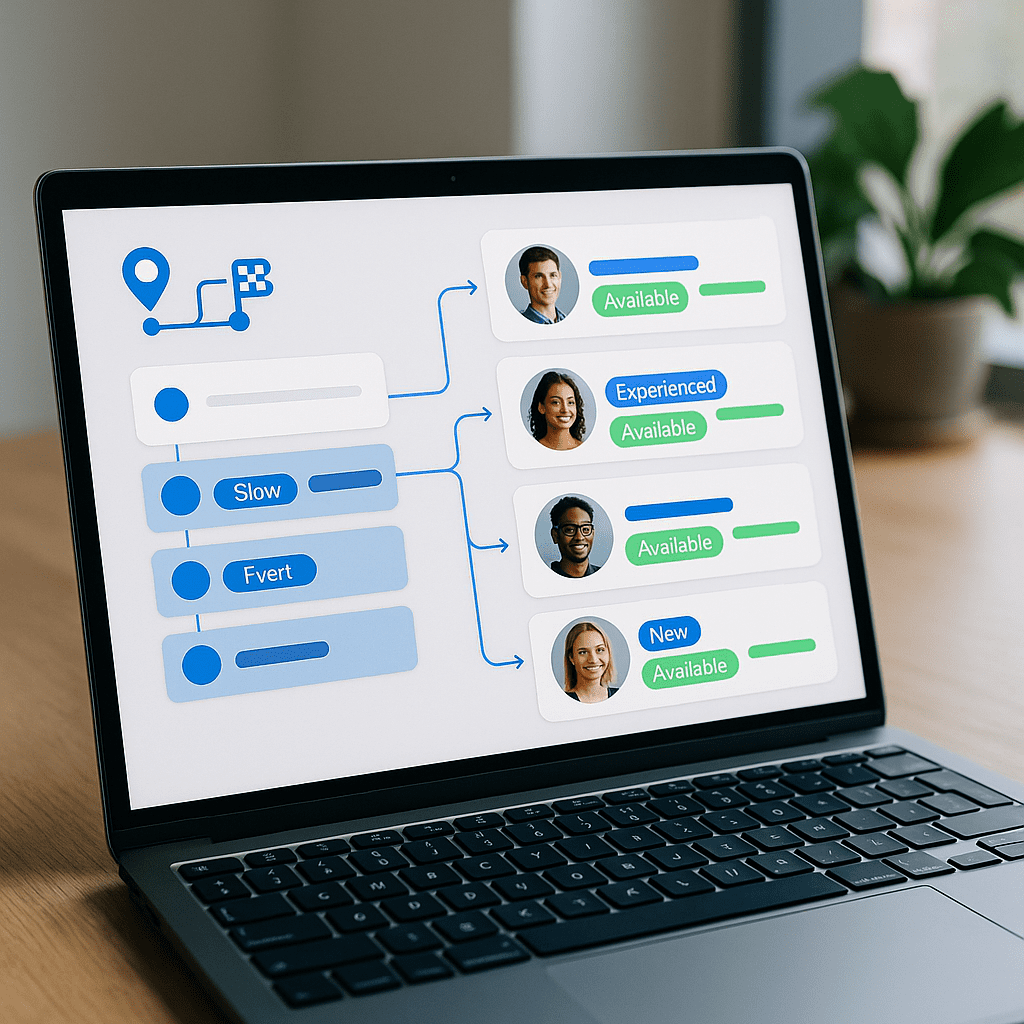
Only 27% of leads are ever contacted by a sales or service rep at the right time and with the right expertise.
In many organizations, high-intent leads still get assigned randomly or manually, leading to slow response times and mismatched appointments.
Skill based lead routing for appointments solves this by automatically matching every lead to the best-qualified team member in real time. Table of Contents
- What Is Skill Based Lead Routing for Appointments?
- Why Skill Based Lead Routing
- Core Components of an Effective Skill Based Routing Model
- How to Implement Skill Based Lead Routing
- Skill Based Lead Routing vs.
- Conclusion: Turning Routing Into
Key Takeaways
| # | Key Point Why It Matters |
| 1 | Skill based lead routing for appointments matches leads to the best-fit team member in real time Increases conversions and customer satisfaction |
| 2 | Effective routing combines skills, availability, priority, and business rules Ensures speed and quality in every booked meeting |
| 3 | Implementing routing requires clean data, clear skills taxonomy, and integration with scheduling tools Prevents errors and manual workarounds |
| 4 | Skill-based routing outperforms simple round robin or territory models in complex environments Aligns expertise with lead intent and complexity |
| 5 | Continuous monitoring and optimization are critical for long-term success
What Is Skill Based Lead Routing for Appointments?
Skill based lead routing for appointments is an automated process that assigns incoming leads to the most suitable team member based on predefined skills, expertise, and availability. Instead of treating all reps as interchangeable, it uses structured criteria such as product knowledge, language, industry vertical, or seniority level to determine who should handle each appointment. In practice, this means that when a lead submits a booking form or requests a meeting, your system immediately:
-
Evaluates the lead’s characteristics (e.g., segment, product interest, region)
-
Matches them against your team members’ skills and calendars
-
Presents available time slots with the best-fit person, or automatically books the meeting
Pro tip: Think of skill based lead routing for appointments as "intelligent matchmaking" between lead needs and rep capabilities, not just an automation rule. Typical use cases
-
SaaS sales teams routing demos based on product line expertise
-
Financial advisors matching clients by investment complexity or portfolio size
-
Healthcare providers assigning patients to clinicians with the right specialty
-
Higher education teams routing prospective students to suitable advisors
For example, if you are a fitness brand evaluating tools from the article Best Online Booking Systems for Fitness and Personal Trainers: Detailed Comparison & Buyer’s Guide], skill-based rules can ensure that advanced athletes are booked with the right trainer while beginners are routed to onboarding specialists. Why Skill Based Lead Routing
for Appointments Drives Better Results Skill based lead routing for appointments is not merely a workflow improvement. It is a revenue and customer experience strategy with measurable impact on:
-
Conversion rates
-
Sales cycle length
-
No-show rates
-
Customer satisfaction and retention
1. Higher conversion and close rates
When leads speak with someone who deeply understands their problem and context, they convert at higher rates. Skill-based routing ensures:
-
Enterprise leads reach enterprise reps
-
Technical buyers speak to technical sellers or solutions consultants
-
VIP clients are matched with senior staff
This alignment increases the probability of:
-
Relevant discovery questions
-
Tailored demos or consultations
-
Clear next steps and faster decisions
Pro tip: Monitor conversion rates by skill segment (e.g., by product line or seniority) to validate and refine your routing logic over time.# 2. Faster speed-to-lead and reduced leakage Time kills deals.
By automating assignment, skill-based routing:
-
Eliminates manual round-robin assignment in Slack or spreadsheets
-
Reduces handoff delays between marketing and sales
-
Ensures every qualified lead receives an immediate scheduling option
When combined with modern scheduling platforms discussed in Best Online Appointment Scheduling Software: 7 Top Tools Compared for Modern Businesses], you can present real-time availability as soon as the lead raises their hand.# 3. Better customer experience
and NPS Customers expect personalized, expert interactions. Skill based lead routing for appointments helps you provide:
-
Relevant expertise on the first call
-
Reduced transfers and escalations
-
Higher-quality consultations for complex needs
This is particularly relevant in regulated or complex sectors such as finance, healthcare, and education.
For example, education institutions that apply routing logic on top of strategies described in [9 Smart Ways to Streamline Appointment Scheduling for Higher Education and K‑12] can connect students to advisors based on program, language, and time zone.# 4. Balanced workloads and better team utilization Skill-based routing can be combined with capacity rules to:
-
Avoid overloading your top performers
-
Ramp new reps by routing them appropriate lead types
-
Maintain service-level objectives across all skills
Pro tip: Use capacity thresholds (e.g., max daily meetings per rep) alongside skill rules to protect your team from burnout while maintaining coverage. Core Components of an Effective Skill Based Routing Model
Before implementing skill based lead routing for appointments, you need a clear framework. The most effective models usually include the following components.# 1. Well-defined skills and attributes
You cannot route on skills you have not clearly defined. Start by designing a skills taxonomy with attributes such as:
-
Product or service specialization
-
Industry or vertical expertise
-
Language proficiency
-
Deal size or segment expertise (SMB, mid-market, enterprise)
-
Region or time zone coverage
-
Role type (sales, success, implementation, advisor)
Pro tip: Keep your initial skill set lean and high-impact; you can add granularity later once your data proves where it is needed.# 2. Accurate rep profiles and calendars Every team member needs
a complete profile that includes:
-
Skills and proficiency levels (e.g., beginner, intermediate, expert)
-
Working hours and time zone
-
Maximum meetings per day/week
-
Meeting types they accept (demo, consultation, onboarding, renewal)
This profile must be synced with your appointment scheduling system.
To ensure clean implementation, follow a structured setup process like the one in How to Set Up Online Appointment Scheduling Software: A Step‑by‑Step Guide for Busy Teams.
3. Intelligent matching and prioritization rules Your routing engine should evaluate both lead data and rep data. Key factors include:
-
Minimum skill requirements for specific lead types
-
Priority segments (e.g., inbound demo > newsletter signup)
-
Capacity and availability at the requested time
-
Fallback rules (what happens if no perfect match is available?)
4. Integrated scheduling and reminders Routing is only effective
if the appointment actually happens. Combine skill-based rules with:
-
Real-time calendar syncing
-
Automated confirmations
-
SMS and email reminders
For guidance on reducing no-shows, see Automated SMS and Email Appointment Reminders: The Complete Guide for Busy Teams. Pro tip: Treat routing, scheduling, and reminders as a single workflow; fragmented tools create gaps that cost you meetings and revenue. How to Implement Skill Based Lead Routing
for Appointments Step-by-Step This section outlines a practical roadmap to implement skill based lead routing for appointments in your organization. Step 1: Map your lead types
and journeys Start with your lead flows, not your org chart. Document:
-
Sources: website forms, live chat, outbound sequences, referrals
-
Intent levels: demo, trial, consultation, pricing request, general inquiry
-
Key qualifiers: company size, industry, region, product interest, urgency
Group these into a small number of lead types.
Pro tip: Limit yourself to 5–8 primary lead types at first; over-segmentation will slow down implementation and confuse stakeholders. Step 2: Define necessary skills per lead type
For each lead type, specify the minimum skills required. Example:
-
Enterprise demo (North America)
-
Product: Platform Enterprise
-
Segment: Enterprise
-
Region: North America
-
Language: English
-
Onboarding session (Spanish-speaking SMB)
-
Product: Core
-
Segment: SMB
-
Language: Spanish
Translate these requirements into routing rules in your system. Step 3: Build and validate rep profiles Collect data for each team member:
-
Skills and subskills
-
Seniority or proficiency level
-
Schedules and time zones
-
Maximum appointment load
Validate this data with managers to avoid inaccuracies.
Pro tip: Use a simple form or internal survey to collect skills data, and require manager approval before importing it into your routing logic. Step 4: Configure routing rules
in your scheduling platform Use your scheduling tool (such as those compared in Best Online Appointment Scheduling Software: 7 Top Tools Compared for Modern Businesses]) to set up:
-
Skill-based assignment rules
-
Conditional logic based on form responses
-
Fallback strategies when no ideal rep is available
At this stage, you will also decide whether to:
-
Present one rep’s calendar directly, or
-
Present pooled availability (team calendar) that still respects skills
For team-based booking, you may combine skill-based logic with methods described in [7 Smart Ways to Use Round Robin Meeting Scheduling for High-Performing Teams. Step 5: Integrate with CRM
and marketing tools Integrate routing outcomes with your CRM so that:
-
Assigned owner is updated automatically
-
Activities and appointment outcomes are logged
-
Lead scoring and statuses remain accurate
This ensures end-to-end visibility and allows you to attribute revenue back to routing rules. Step 6: Monitor, analyze,
and optimize After launch, track metrics by skill, segment, and rep:
-
Booking rate from lead to scheduled appointment
-
Show rate (attendance)
-
Conversion from appointment to opportunity or sale
-
Time to first meeting
Use this data to:
-
Refine skills definitions and thresholds
-
Adjust capacity rules for overloaded skills
-
Identify training needs for underperforming segments
Pro tip: Schedule a quarterly routing review meeting with sales, marketing, and operations to evaluate data and adjust your rules systematically. Skill Based Lead Routing vs.
Other Routing Methods Skill based lead routing for appointments is one of several routing strategies. Understanding the differences will help you choose the right mix for your team. Common routing models compared Routing Model
How It Works Strengths Limitations Simple round robin Assigns leads in equal rotation among reps Fair distribution, easy to implement Ignores skills, expertise, and complexity Territory-based Routes leads based on region or geography Clear ownership, localized knowledge Fails when expertise differs within territories Role-based Assigns based on team or function (SDR, AE, CSM) | Aligns to sales process stages Still treats reps within a role as interchangeable |
| Skill-based Matches lead attributes to rep skill profiles Highest relevance, better CX, higher conversions Requires more setup and data maintenance |
| Hybrid (skill + round robin) | Uses skills filters, then rotates among qualified reps Balances fairness with expertise More complex rule management In many organizations, a hybrid approach is optimal.
For example:
- First filter by skill requirements (product, language, segment)
- Then use round robin among the qualified subset
Pro tip: If you already use basic round robin, add a skill filter layer before the rotation; this incremental step often delivers a fast performance uplift with minimal disruption. When to adopt skill based lead routing
for appointments Skill-based routing is particularly valuable when:
-
You have multiple products or complex offerings
-
Your team spans multiple languages or regions
-
You serve distinct segments (e.g., SMB vs. enterprise)
-
Lead volume is high enough that manual assignment is impossible
Smaller teams with simpler offerings can still benefit from basic skills logic, especially around time zones and languages. Conclusion: Turning Routing Into
a Competitive Advantage Skill based lead routing for appointments transforms appointment scheduling from a logistical task into a strategic growth lever. By intelligently matching lead needs with team expertise, you can:
-
Increase conversion rates and revenue
-
Improve customer experience from the very first interaction
-
Reduce no-shows and wasted meetings
-
Balance workloads and accelerate rep development
To move forward:
-
Map your lead types and define the minimum skills required for each.
-
Build accurate rep skill profiles and integrate them with your scheduling system.
-
Implement and test routing rules, starting with a small set of high-impact skills.
-
Combine routing with robust scheduling processes, such as those in How to Set Up Online Appointment Scheduling Software: A Step‑by‑Step Guide for Busy Teams. 1. Add automated reminders, as outlined in Automated SMS and Email Appointment Reminders: The Complete Guide for Busy Teams], to protect your calendar and reduce no-shows.
When thoughtfully implemented and continuously optimized, skill based lead routing for appointments becomes a durable competitive advantage that compounds over time, turning every inbound inquiry into a carefully matched, high-quality conversation.

