

Over half of American service businesses face lost revenue due to missed appointments and manual scheduling errors. For small business owners, each no-show means wasted time and lost opportunities for growth. Appointment automation is changing this reality by reducing administrative effort and giving clients a seamless booking experience. Discover how smart scheduling tools can help American businesses engage clients more effectively while slashing no-shows and freeing staff to focus on service quality.
Table of Contents
- Appointment Automation Defined and Debunked
- Major Types of Appointment Automation Tools
- Essential Features for Streamlined Scheduling
- Real-World Applications Across Industries
- Costs, Risks, and Common Pitfalls to Avoid
Key Takeaways
| Point | Details |
|---|---|
| Appointment Automation Enhances Efficiency | Automated scheduling reduces manual intervention and booking errors, allowing businesses to save up to 80% of scheduling time. |
| Intelligent Tools for Diverse Industries | Various appointment automation tools, like predictive scheduling systems and AI-powered assistants, optimize booking across sectors such as healthcare and consulting. |
| Essential Features Drive Client Satisfaction | Real-time availability, advanced notifications, and predictive analytics not only streamline scheduling but also improve client engagement and reduce no-shows. |
| Consider Costs and Risks | Implementation requires careful planning around financial investments, user training, and potential technological risks to ensure successful adoption. |
Appointment Automation Defined and Debunked
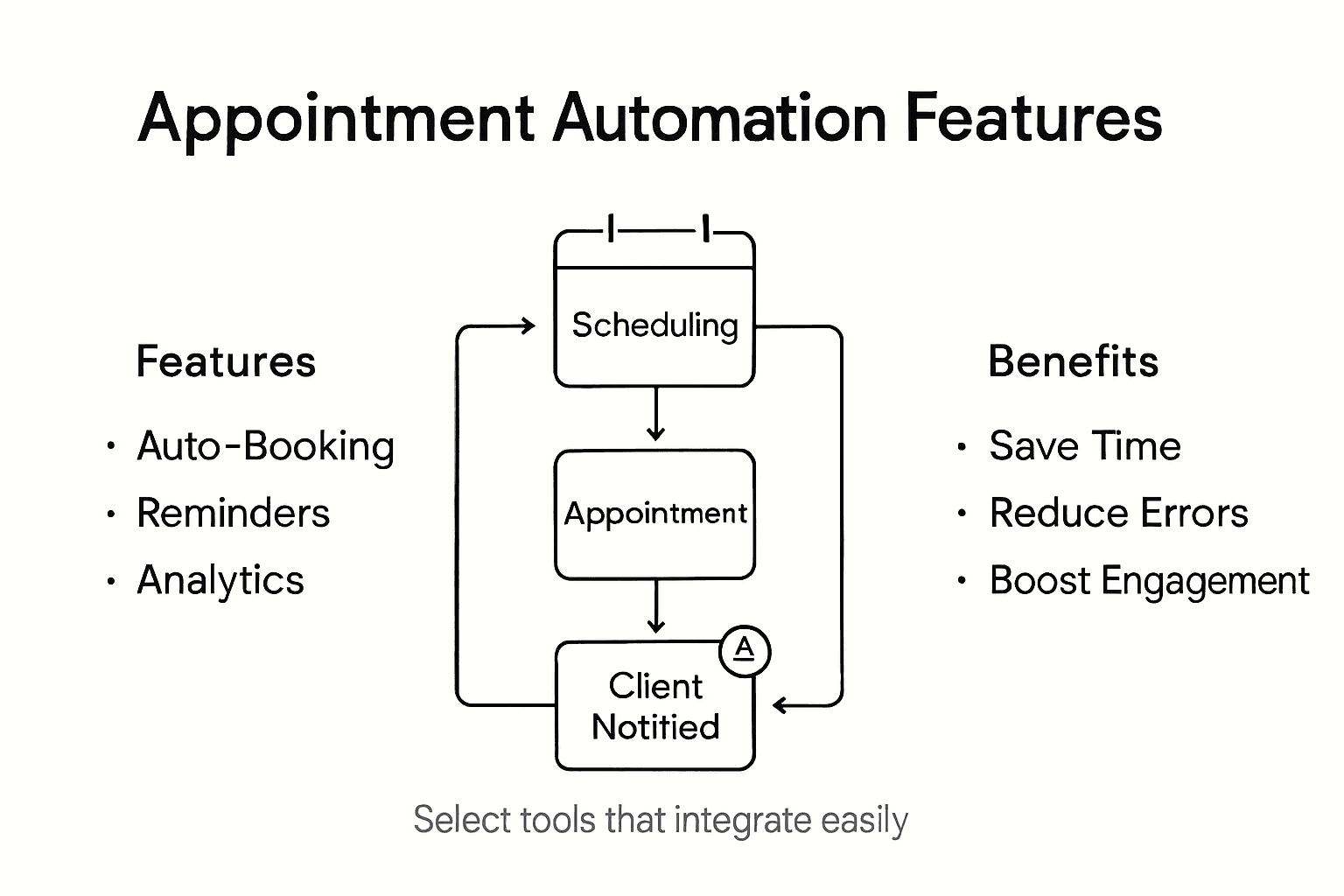
Appointment automation represents a strategic technological approach that leverages digital tools to streamline client scheduling processes. At its core, this innovative solution transforms traditional manual booking methods by introducing intelligent, efficient mechanisms for managing appointments across various service industries.
Traditionally, scheduling required significant human intervention, creating bottlenecks and potential errors. Today, advanced scheduling technologies integrate AI and machine learning to create seamless, intelligent booking experiences. These systems can automatically route clients to appropriate service providers, synchronize calendars in real time, and even predict optimal scheduling windows based on historical data.
Contrary to common misconceptions, appointment automation does not eliminate human interaction but actually enhances client engagement. By removing administrative friction, businesses can focus more on personalized service delivery. Modern automation platforms enable features like customized booking pages, automated reminders, and flexible scheduling options that give clients greater control while reducing no-show rates and administrative overhead.
- Reduces manual scheduling time by up to 80%
- Provides 24/7 booking availability
- Minimizes scheduling errors
- Offers real-time calendar synchronization
- Supports multiple communication channels
Pro tip: Start with a simple automation strategy by selecting a platform that integrates smoothly with your existing client management systems and offers customizable features to match your specific business workflow.
Major Types of Appointment Automation Tools
Appointment automation tools represent a sophisticated technological ecosystem designed to streamline scheduling processes across various industries. These systems have evolved far beyond simple calendar management, incorporating advanced algorithmic approaches to optimize booking efficiency and client engagement.
Advanced scheduling technologies utilize multiple strategic approaches, ranging from operations research models to machine learning algorithms. The primary categories of appointment automation tools include:
-
Predictive Scheduling Systems
- Utilize machine learning to forecast no-show probabilities
- Dynamically adjust appointment slots based on historical data
- Optimize resource allocation and time management
-
Integer Linear Optimization Tools
- Apply mathematical modeling to scheduling challenges
- Create precise appointment allocation strategies
- Minimize scheduling conflicts and maximize efficiency
-
AI-Powered Scheduling Assistants
- Integrate natural language processing
- Provide intelligent routing and booking recommendations
- Adapt to complex scheduling requirements
These sophisticated tools not only automate booking processes but also provide strategic insights that help businesses reduce administrative overhead, improve client satisfaction, and optimize resource utilization. By leveraging data-driven approaches, organizations can transform their scheduling from a manual, error-prone task to a streamlined, intelligent system.

Pro tip: When selecting an appointment automation tool, prioritize platforms that offer seamless integration with your existing systems and provide robust analytics to continuously improve your scheduling strategies.
Essential Features for Streamlined Scheduling
Appointment scheduling automation has transformed from a simple digital convenience to a sophisticated strategic tool for businesses seeking operational excellence. Modern scheduling systems go far beyond basic calendar management, offering comprehensive features that dramatically improve client engagement and organizational efficiency.
Intelligent appointment automation systems integrate multiple critical features designed to create seamless, responsive booking experiences. The most essential features include:
-
Real-Time Availability Management
- Instant calendar synchronization
- Dynamic slot updating
- Preventing double bookings
-
Advanced Notification Systems
- Automated appointment reminders
- Multi-channel communication (SMS, email, app notifications)
- Customizable reminder intervals
-
Predictive Analytics Capabilities
- No-show probability forecasting
- Resource allocation optimization
- Intelligent rescheduling recommendations
These sophisticated features work synergistically to reduce administrative overhead, minimize scheduling friction, and create a more responsive client interaction environment. By leveraging data-driven insights and automation technologies, businesses can transform their scheduling from a manual, error-prone process into a strategic competitive advantage.
Here’s a look at how key appointment automation features support business outcomes:
| Feature | How It Works | Business Impact |
|---|---|---|
| Real-Time Availability | Instantly updates and syncs calendars | Reduces double booking risks |
| Advanced Notifications | Sends automated reminders via multiple channels | Cuts down on missed appointments |
| Predictive Analytics | Forecasts no-shows and suggests rescheduling | Maximizes resource utilization |
| Custom Booking Pages | Tailors client experience and services | Increases client satisfaction |
Pro tip: Evaluate scheduling tools by testing their integration capabilities and looking for platforms that offer granular customization to match your specific business workflow and client communication preferences.
Real-World Applications Across Industries
Appointment automation has emerged as a transformative technology that transcends traditional industry boundaries, offering strategic advantages across diverse business sectors. Far from being a one-size-fits-all solution, these intelligent scheduling systems adapt to the unique operational requirements of different professional environments.
Advanced scheduling technologies demonstrate remarkable versatility in real-world applications, revolutionizing how organizations manage time-sensitive interactions. The most compelling implementations span multiple critical industries:
-
Healthcare Sector
- Reduce patient no-show rates
- Optimize clinic resource allocation
- Minimize waiting times
- Streamline multi-provider scheduling
-
Manufacturing and Production
- Coordinate complex equipment maintenance schedules
- Manage workforce shift assignments
- Track predictive maintenance windows
- Balance production line efficiency
-
Service and Consulting Industries
- Automate client consultation bookings
- Provide intelligent routing to appropriate specialists
- Enable flexible rescheduling options
- Implement smart reminder systems
These innovative applications demonstrate how appointment automation transforms traditional scheduling from a manual, error-prone process into a strategic operational tool. By leveraging data-driven insights and intelligent routing, businesses can create more responsive, efficient client engagement models that adapt to dynamic market demands.
The table below summarizes how appointment automation transforms scheduling in different industries:
| Industry | Main Automation Benefit | Typical Use Case |
|---|---|---|
| Healthcare | Reduces appointment gaps | Multi-provider calendar syncing |
| Manufacturing | Improves equipment uptime | Automated maintenance scheduling |
| Consulting/Services | Streamlines client booking | Intelligent specialist routing |
Pro tip: Conduct a comprehensive workflow analysis before implementing appointment automation to identify specific pain points and customize the system to your organization’s unique scheduling requirements.
Costs, Risks, and Common Pitfalls to Avoid
Appointment automation represents a powerful technological investment that requires strategic planning and comprehensive understanding. While these systems offer tremendous operational benefits, businesses must carefully navigate potential challenges to ensure successful implementation and maximize return on investment.
Deploying appointment automation systems involves complex considerations around costs, risks, and potential implementation challenges. The key areas of concern include:
-
Financial Considerations
- Initial software acquisition costs
- Integration expenses
- Ongoing maintenance and upgrade fees
- Training and change management investments
-
Technological Risks
- Data privacy and regulatory compliance
- Technical system failures
- Potential scheduling algorithm errors
- Security vulnerabilities
-
Operational Challenges
- Inadequate user training
- Overreliance on automated systems
- Reduced human oversight
- Potential exclusion of less tech-savvy users
Successful implementation requires a holistic approach that balances technological capabilities with human expertise. Organizations must develop robust strategies that incorporate comprehensive testing, continuous monitoring, and flexible adaptation to mitigate potential risks and maximize the transformative potential of appointment automation technologies.
Pro tip: Conduct a pilot program with a small user group to identify and address potential implementation challenges before full-scale deployment.
Elevate Your Client Engagement with Smarter Appointment Automation
Struggling with scheduling inefficiencies and no-shows can hold back your business growth and frustrate your clients. This article highlights how appointment automation, featuring smart routing, real-time calendar synchronization, and predictive analytics, revolutionizes client engagement while reducing manual overhead. If you want to embrace a solution that cuts scheduling errors, enhances client control, and streamlines operations across your service business, the right platform is essential.
Take the next step today by exploring how Bookafy delivers an all-in-one appointment automation experience tailored to your needs. From customizable booking pages to automated reminders and video call integration, Bookafy is designed to boost your client satisfaction and reduce no-shows. Discover the full power of smart scheduling automation that adapts to your unique workflow and see why businesses trust Bookafy to enhance their client interactions and operational efficiency. Visit Bookafy now and start transforming your appointment management strategy.
Frequently Asked Questions
What is appointment automation?
Appointment automation is a technology-driven approach that uses digital tools to streamline the scheduling process for clients across various service industries, transforming traditional manual methods into efficient, intelligent booking systems.
How can appointment automation enhance client engagement?
Appointment automation enhances client engagement by removing administrative friction, allowing businesses to concentrate on personalized service delivery. It provides features like customized booking pages and automated reminders, giving clients greater control and reducing no-show rates.
What features should I look for in an appointment automation tool?
Key features to consider include real-time availability management, advanced notification systems, and predictive analytics capabilities. These features help minimize scheduling errors, improve client communication, and optimize resource utilization.
What industries can benefit from appointment automation?
Appointment automation can be beneficial in various industries, including healthcare, manufacturing, and consulting. It helps reduce no-show rates, streamline scheduling processes, and improve overall operational efficiency.
Recommended
- Appointment Booking Software - SMB To Enterprise
- 5 Reasons To Use Online Scheduling For Your Business | Bookafy
- Continue To Give Appointment Booking Integration | Bookafy
- Scheduling Software Buyers Guide | Bookafy
Try Bookafy free
Put online booking, automatic reminders, and calendar sync to work for your business. Free to start — no credit card required.
Start your free trial See how it works →Frequently asked questions
What is the best appointment scheduling software for a small business?
Bookafy is appointment scheduling software built for small businesses: clients book online 24/7, automatic text and email reminders cut no-shows, and your calendars stay in sync — at a friendly per-user price.
Does Bookafy reduce no-shows?
Yes. Bookafy sends automatic text and email reminders before every appointment, which is one of the most effective ways to reduce no-shows.
Can clients book online 24/7 with Bookafy?
Yes. Bookafy gives you a booking page and embeddable widget so clients can self-schedule any time, from your website, Google, or a shared link.
How much does Bookafy cost?
Bookafy is a simple monthly subscription with a free trial and no credit card required. See the pricing page for current plans.
Related: Appointment scheduling software · Why Bookafy · Pricing
Save time with automated scheduling
Bookafy handles online booking, reminders, and calendar sync so you can focus on the work.
Try Bookafy free
Bookafy — online appointment scheduling for growing businesses.