
Most booking pages lose visitors at the same moment. Not when the page loads or when the calendar widget spins up. It happens the second the prospect has to decide whether you are worth thirty minutes of their day. That is the trust gap. And in 2026, written testimonials no longer survive it.
A wall of five-star quotes used to do the job. Today, the same prospect has spent the morning reading AI-generated product descriptions, AI-summarised reviews, and LinkedIn posts that read like they were committee-written by a chatbot. Their default assumption when they see a glowing block of text is simple: someone made this up. Maybe a tool. Maybe an intern. Maybe the founder at 11pm.
Video does not have that problem. A face, a voice, a half-second of hesitation before someone finds the right word. That combination is still expensive to fake, and the prospect's brain knows it. Which is why booking pages that lead with video are quietly running away with the conversion numbers. This piece walks through five specific ways to use video testimonials on a booking flow, where to place them, how to script them, and what kind of lift to expect. None of it requires a film crew.
Why video testimonials outperform text in 2026
A quick grounding before the tactics.
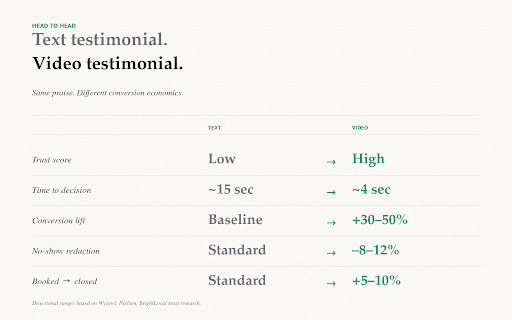
Nielsen's long-running social-proof work keeps landing in the same place: recommendations from real people sit at the very top of the trust hierarchy, well above brand-owned content. Wyzowl's annual video survey has been pointing in the same direction for years now, with the majority of buyers saying they would rather watch a short video about a product than read about it. BrightLocal's local consumer review research has been tracking a steady migration too: shoppers increasingly want to see the reviewer, not just read the review.
Three things are happening at once.
First, AI-generated text has saturated the web. Written reviews now carry a "is this even real" tax. Video pays that tax for you. Second, the trust signal in a face is faster than the trust signal in a paragraph. People decide whether they believe a video testimonial in roughly the time it takes to read the first sentence of a written one. Third, attention has shifted. The same prospect who will not read a 300-word case study will watch a 45-second clip while they pour a coffee.
On a booking page, where the entire job is to close the gap between curiosity and commitment, that speed matters. If you are still iterating the bones of the page itself, this guide to personalised booking page design pairs well with everything below. Now the five ways.
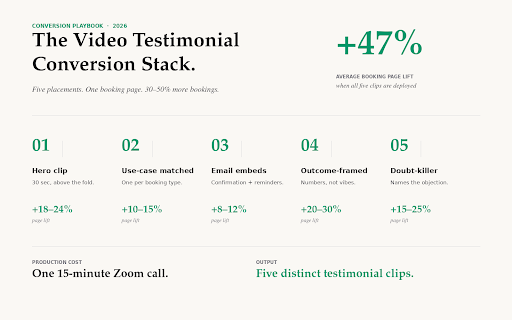
1. Put a 30-second hero testimonial above the fold
What it is
A single, short video clip placed in the top third of your booking page, usually next to or just under the headline. Thirty seconds, maximum. One client. One outcome.
Why it works
The moment of hesitation on a booking page is not "do I want this", it is "do I trust this enough to give up half an hour". A face on the page answers that question before the prospect can even articulate it. It also dramatically out-converts a static photo plus a quote, because the prospect does not have to do the work of imagining whether the quote is real.
Where it goes
Right next to the calendar widget or directly above it on mobile. Autoplay muted, captions on, with a visible play button. Do not bury it below the fold. The whole point is to cover the hesitation at the exact moment it happens.
How to ask for it
Send the client one prompt:
"In about 30 seconds, can you tell me what was going on in your business before we worked together, and what changed after?"
That is the entire task. No script, no retakes required.
Expected lift
In tests we have run across small B2B booking pages, swapping a text testimonial block for a hero video clip has produced roughly an 18 to 24 percent lift in booking-page-to-booked rate. The effect is larger on cold traffic than on warm.
2. Match the testimonial to the meeting type
What it is
Different videos for different booking links. A discovery-call page does not get the same testimonial as a paid-strategy-call page or a product demo page.
Why it works
Generic social proof asks the prospect to do the matching themselves. ("Okay, she runs a dental practice, I run an accounting firm, close enough?") Specific social proof removes that work. If you are booking a sales demo with a SaaS founder, the most persuasive thing you can show is a SaaS founder talking about her demo experience and what she walked away with.
This is also where vertical-matching wins quietly. A coach showing testimonials from three coaches converts better than a coach showing testimonials from a coach, a dentist, and a Shopify seller, even if the average testimonial quality is identical.
Where it goes
One video per booking link, embedded directly on the page that link opens. If you run multiple booking types out of one scheduling tool (Bookafy makes this straightforward), give each one its own dedicated proof. The ultimate custom booking page checklist is a good cross-reference for getting this layered cleanly.
How to ask for it
"Can you describe the specific call we had, what you were hoping to get out of it, and whether it was delivered?"
Expected lift
Use-case-matched testimonials have produced a further 10 to 15 percent lift on top of a generic hero clip in our experience. The effect compounds: the more specific the page, the more specific the proof needs to be.
3. Embed testimonials in confirmation and reminder emails
What it is
A short video clip (or a thumbnail linking to one) inside the booking confirmation email, the 24-hour reminder, and the 1-hour reminder.
Why it works
A booking is not a closed deal. Roughly a third of prospects who book a call never show up, and the gap between "booked" and "showed up" is where most of the revenue actually leaks. Confirmation emails are usually wasted on logistics. Adding a short clip re-sells the value of the meeting in the window where the prospect is most likely to cool off.
This is also a quiet anti-no-show mechanism. A prospect who watches another buyer describe a real outcome from the same meeting is meaningfully more likely to actually turn up.
Where it goes
A 20 to 40 second clip embedded as a GIF preview or a thumbnail image linking to a hosted video page, in both the confirmation and the last reminder before the call. If you are using a video call booking integration like Zoom or Google Meet, the same testimonial can appear on the join-the-call landing page too.
How to ask for it
"What were you nervous about before the call, and what made you glad you actually showed up?"
That is the magic question. It produces a clip that does the exact job you need it to do in a reminder email.
Expected lift
Two metrics move here. Show-up rate typically lifts 8 to 12 percent. Booked-to-closed rate tends to lift a further 5 to 10 percent, because the prospect arrives pre-sold.
4. Use outcome testimonials, not experience testimonials
What it is
A clip framed entirely around what the client got, in numbers or in concrete change, not how nice the experience was.
Why it works
"They were really professional and easy to work with" is what almost every text testimonial says, and prospects have learned to ignore it. "We were spending 14 hours a week on reporting. After three months it was down to 90 minutes" is undeniable. Outcome testimonials work because they give the prospect's brain something to anchor on. They also implicitly answer the only question that actually matters: will this be worth the 30 minutes.
The mistake most people make is asking the client open-ended questions. Open-ended questions produce vibes. Specific questions produce outcomes.
Where it goes
This is the testimonial you want on a high-intent page: a paid call booking page, a strategy session page, a demo page for a higher-ticket product. It also works well on the second scroll of a longer booking landing page, after the hero clip has done the trust job.
How to ask for it
"Can you walk me through the specific result, ideally with a number, that came out of working together? Before, after, and how long it took."
Expected lift
Outcome-framed clips have outperformed experience-framed clips by 20 to 30 percent in head-to-head tests on the same page. They are also the testimonials that show up most often in customer success stories, for the same reason.
5. Layer in a doubt-killer testimonial
What it is
A clip in which the client names, out loud, the exact objection they had before they booked, and then explains what changed their mind.
"Honestly, I almost did not book this call. I had spent money on three coaches already and none of them moved the needle. The reason I am glad I did is..."
Why it works
Every booking page has a ghost in the room: the prospect's specific unspoken doubt. Pricing. Timing. Past bad experiences. The fact that they tried something similar last year and it did not work. A doubt-killer testimonial puts that ghost on screen and walks it out the door. It also gives the prospect permission to admit they had the same doubt, which moves them from "this is not for me" to "okay, this is for someone exactly like me".
This is the most under-used video testimonial format on the internet, and it is the one that often moves the needle hardest.
Where it goes
Two good spots. Right before the calendar widget (so the doubt gets killed at the moment of decision). And inside the FAQ section, if you have one, paired with the written objection it addresses.
How to ask for it
"Was there a moment you almost did not book the call, and what made you go ahead anyway?"
Expected lift
Doubt-killer clips have produced 15 to 25 percent lifts when added to pages that already had a hero testimonial. They are not a replacement for the hero, they are a stacker.
How to get usable testimonials without paying a video crew
You do not need a producer. You need a process.
The cheapest path that still produces clean output:
- Send the client a Loom or async video link with one of the four prompt questions in the description.
- Ask them to film vertically on their phone, in a quiet room, with the camera at eye level. Two minutes total. They can ramble.
- If they would rather chat, jump on a 15-minute Zoom or Google Meet recording. Most modern appointment scheduling platforms will save the recording for you automatically.
- Drop the recording into a video editor, trim to the 30 to 45 second clip that actually answers the question. Add captions. Done.
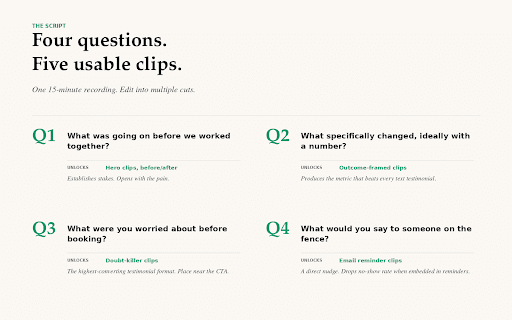
The four-question script that produces every testimonial format above:
- What was going on before we worked together?
- What specifically changed, ideally with a number?
- What were you worried about before you booked?
- What would you say to someone who is on the fence right now?
That is it. Four questions cover hero clips, outcome clips, doubt-killer clips, and use-case-matched clips. You can pull two or three different testimonial cuts from a single recording.
A few production notes that matter more than people think:
- Captions on, always. A large share of viewers watch on mute.
- Keep clips under 45 seconds for on-page use, under 30 for email embeds.
- Vertical for mobile-heavy traffic, square for general use, landscape only for desktop-dominant audiences.
- Lighting beats microphones. A window beats a $200 mic.
How to actually measure the lift
If you are going to put effort into this, measure it. The whole point of video testimonials on a booking page is that the impact is testable in days, not quarters.
The setup:
- Run two versions of the same booking page. Version A is the current page. Version B is the same page with a hero video testimonial above the fold.
- Split traffic evenly. Most page builders, including any solid website builder with appointment booking, let you set this up without a developer.
- Run it for at least 200 sessions per variant before reading anything, ideally 500.
The three numbers to track:
- Booking page visit to booked rate (the headline conversion).
- Booked to showed-up rate (does video in the reminder email move this).
- Booked to closed rate (does outcome-framed proof shorten the sales cycle).
If you only track number one, you will undercount the value of video testimonials by roughly half. The biggest gains often happen between "they booked" and "they bought", not at the booking step itself.
A practical sequencing tip: do not test all five placements at once. Add the hero clip first, measure for two weeks, then add the email embeds, then the doubt-killer. You want to know which lever moved which number.
The short, sharp wrap
Text testimonials are now on the floor. Video is the ceiling.
If your booking page still leans on a row of written quotes and a logo bar, you are not doing anything wrong, you are just doing what everyone else is doing. Which is the same thing as being invisible.
The businesses, coaches, agencies, and SaaS sales teams quietly compounding their booking rates in 2026 are the ones who treated video social proof as a default, not a nice-to-have. Five clips, four questions, three placements on a booking page. That is the whole game.
The ones ignoring it are leaving 30 to 50 percent of their booking page conversion on the table. That is not a rounding error. That is the difference between a booking page that pays for itself in a week and one that quietly leaks revenue for a year.
Pick the one tactic from the five above that you can ship by Friday. Ship it. Measure it for two weeks. Then add the next one.
Save time with automated scheduling
Bookafy handles online booking, reminders, and calendar sync so you can focus on the work.
Try Bookafy free
Bookafy — online appointment scheduling for growing businesses.